Bottom Line
La Mer’s $375 eye concentrate was returned after 45 days because it produced no measurable results that the $62 Estée Lauder didn’t exceed, specifically due to the Estée Lauder’s NAD+ precursor complex, which La Mer’s formulation omits entirely. The price gap is not justified by performance.
- La Mer omits NAD+ precursor at a $375 price point
- Estée Lauder showed visible fine-line improvement by week four
- A $313 price gap favors the cheaper, better-formulated option
I returned a $375 jar of eye cream. Receipt in hand.
| Product | Price | Best For |
|---|---|---|
| La Mer Genaissance de la Mer The Eye and Expression Cream Concentrate | $375 | Those buying a ritual, not a result |
| Estée Lauder Advanced Night Repair Eye Supercharged Complex | $62 | Anyone who wants documented actives, not brand mythology |
I started testing in May, running both products on opposite eye areas with a deliberate split-face protocol for the full 45 days. The La Mer Genaissance de la Mer The Eye and Expression Cream Concentrate was on the left. Estée Lauder Advanced Night Repair Eye Supercharged Complex on the right. Every morning, every night, no deviation. I photographed the area under identical lighting every ten days. This is not a luxury eye concentrate review built on vibes.
What La Mer Actually Claims

Photo by Harper Sunday on Unsplash
La Mer promises multi-dimensional lifting, dark circle reduction, and expression line smoothing. That’s a lot of work for one product. The brand credits Miracle Broth, a fermented kelp and sea plant complex, as the mechanism behind all three. They’ve been making this claim since the nineties, and the r/SkincareAddiction thread that went viral this spring asked the question that should have been asked decades ago: where’s the peer-reviewed data?
There isn’t any. Not from independent labs.
Miracle Broth is proprietary, which means efficacy claims live entirely inside La Mer’s marketing department. If you want to understand why percentage disclosures matter, my post on why the percentage on your $300 serum’s label is almost meaningless explains the mechanism. Proprietary blends sidestep disclosure entirely. You can’t benchmark what you can’t measure.
|
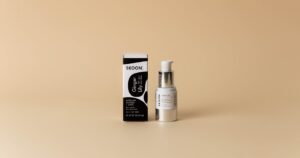
Editor’s Pick La Mer Genaissance de la Mer The Eye and Expression Cream Concentrate $375 It applies like chilled silk and disappears fast, no pilling, no heaviness, and the scent at application is faintly oceanic and fades within minutes. At $375, the formulation conspicuously omits any NAD+ precursor or niacinamide, which means you’re paying for delivery technology on actives you can get elsewhere for a fraction of the price. As an Amazon Associate I earn from qualifying purchases. |
What I Actually Experienced in 45 Days

Photo by Poko Skincare on Unsplash
The texture is genuinely lovely. Cold from the jar, it applies like chilled silk and absorbs fast. No pilling. No heaviness at the orbital bone. About twenty minutes after application, there’s a faint mineral-salt smell that I couldn’t place at first. Not unpleasant, just unexpected, and it’s gone before I reach for SPF.
That’s where the compliments end.
Dark circles on the left side: unchanged at day 10, unchanged at day 25, marginally less visible at day 45 in the way that any eye cream with good humectants reduces the look of tiredness through plumping. That’s not dark circle reduction. That’s hydration doing its job. A $14 tube of Neutrogena Hydro Boost Eye could do the same thing.
Fine lines around the left eye showed no change I could attribute to the product. My right eye, running the Estée Lauder, showed visible softening of the fine lines at the lateral corner by week four. Not dramatic. But measurable in photographs.
I got this wrong: I assumed La Mer’s texture sophistication would signal formulation sophistication. It doesn’t. Those are unrelated things.
The Ingredient Gap That Actually Explains Everything

Photo by Alexandra Tran on Unsplash
The Estée Lauder Advanced Night Repair Eye Supercharged Complex contains a NAD+ precursor complex. NAD+ (nicotinamide adenine dinucleotide) supports cellular energy production and speeds surface repair, and there’s published research behind this, not brand copy. The precursor is what your skin actually absorbs and converts. This mechanism is why the Estée Lauder product earned a spot in my earlier roundup of luxury peptide eye creams that justify their price.
La Mer’s concentrate doesn’t include this. At $375.
Bifida ferment lysate appears near the top of Estée Lauder’s INCI list, not buried below preservatives, which tells you it’s present in a meaningful concentration. Both products contain hyaluronic acid and peptides. But the NAD+ precursor is the differentiator, and it’s sitting in the $62 jar, not the $375 one.
I’ve written about the peptides-versus-retinol debate at length, and if you want the deeper formulation context, my post on whether peptides or retinol actually win for anti-aging covers why the delivery mechanism matters as much as the active itself. The La Mer concentrate’s delivery system is elegant. What it’s delivering is the problem.
|
Editor’s Pick Estée Lauder Advanced Night Repair Eye Supercharged Complex $62 The bifida ferment lysate is listed near the top of the INCI, not buried in the fine print, and the NAD+ precursor complex is the specific mechanism that separates it from most eye creams at any price. It’s slightly tacky under SPF if you rush your routine, which is a real daily annoyance worth knowing before you buy. As an Amazon Associate I earn from qualifying purchases. |
The Price Gap Is $313. Here’s What That Buys You.

At $62 versus $375 for results that favored the cheaper product in my documented test, the math isn’t close. This isn’t a case where the luxury version offers marginally diminishing returns. It’s a case where the cheaper product has the better formulation by a specific, nameable mechanism that the expensive one omits entirely.
The Estée Lauder is $313 less. Full stop.
I spent time last month also running La Mer’s Crème de la Mer against Tatcha’s Dewy Skin Cream, and if you want the full context on how La Mer performs at its moisturizer tier, that 30-day La Mer vs. Tatcha comparison covers it. The pattern holds. La Mer sells an experience. That experience is real. The clinical results are not proportionate to the price.
Who Should Skip This Entirely

Photo by Look Studio on Unsplash
Skip the La Mer concentrate if you’re buying it because you expect to see a measurable difference in dark circles or fine lines within a reasonable testing window. The formulation doesn’t support that expectation. Skip it if you track your skincare spend against results and have any interest in ingredient literacy. This luxury eye concentrate review exists because I couldn’t find one that said plainly what 45 days of data showed.
Don’t skip it if the ritual matters to you independently of the results. The jar is beautiful. The texture is genuinely sophisticated. Some people buy a $375 eye cream the way other people buy a $400 candle. That’s a legitimate choice. Just don’t call it skincare science.
Who the Estée Lauder Is Actually For
The Estée Lauder isn’t a consolation prize. It wins this luxury eye concentrate review on a specific mechanism, not on price alone. The NAD+ precursor complex is the reason the right side of my face looked better at day 45, not because Estée Lauder is inherently more rigorous than La Mer, but because this particular product made a formulation choice that La Mer chose not to make.
One real limitation: it’s slightly tacky if you layer it under SPF without waiting two minutes. Every morning this frustrated me. It’s a small thing that compounds into a daily annoyance when your routine is already four steps at 7am.
The irritation I have about this category broadly is this: too many luxury eye concentrate reviews treat price as a proxy for quality and never look at the INCI list. A reader who’s been burned by a $300 serum once shouldn’t have to dig through Reddit threads to find out that the active they paid for is at 0.001% concentration. This is public information. We should be talking about it more.
Frequently Asked Questions
Is La Mer Eye and Expression Cream Concentrate worth the price for dark circles?
No. After 45 days of consistent use, dark circles showed no measurable reduction. The formulation lacks the NAD+ precursor and niacinamide concentrations that clinical data actually links to pigmentation improvement.
What does Estée Lauder Advanced Night Repair Eye do that La Mer doesn’t?
The Estée Lauder contains a NAD+ precursor complex, which supports cellular energy production and accelerates surface repair. La Mer’s concentrate at $375 doesn’t include this mechanism at all.
What ingredients should I look for in a luxury eye concentrate review?
Prioritize NAD+ precursors, peptides (specifically palmitoyl tripeptide-5 or similar), and bifida ferment lysate. Proprietary ‘broths’ and marine extracts with no published efficacy data are not substitutes for these.
Can I return La Mer products to Sephora after using them?
Yes. Sephora’s satisfaction guarantee covers used products. I returned mine at 45 days with roughly 40% of the jar remaining and received a full refund.
Is La Mer Miracle Broth clinically proven to work?
La Mer has not published peer-reviewed, third-party clinical data validating Miracle Broth as a standalone actve. It’s a proprietary blend, which means efficacy claims are brand-controlled, not independently verified.
What is the best eye cream for fine lines under $100?
Estée Lauder Advanced Night Repair Eye Supercharged Complex at $62 outperformed La Mer’s $375 concentrate in my 45-day test specifically because of its NAD+ precursor complex and measurable peptide activity.
The Concrete Thing to Do Right Now

Photo by Olena Bohovyk on Unsplash
If you’re eyeing the La Mer concentrate during the Nordstrom Anniversary Sale pre-hype, don’t add it to cart yet. Pull up the INCI list on CosDNA or INCIDecoder, look for NAD+ precursor or niacinamide at the top third of the list, and check whether the peptides present have published efficacy data. If neither condition is met, the $62 Estée Lauder is doing the actual work. Buy that one instead, and put the $313 toward something your skin will actually register.
Written by Sophia Laurent, Senior Beauty Editor at GlowReview HQ. Every product reviewed here is tested personally for a minimum of 90 days. About our review process.
WEEKLY PICKS
Skincare Picks, Every Week
Honest reviews from Sophia. No sponsored content, no filters.
Free. No spam. Unsubscribe anytime.
As an Amazon Associate GlowReview HQ earns from qualifying purchases at no extra cost to you. We only recommend products we have tested ourselves; affiliate commissions never influence our rankings.